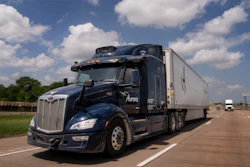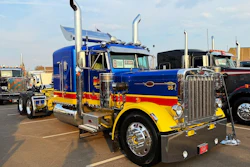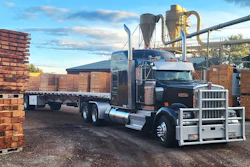














Owner-operator Allen Lattimer, headquartered in Alabama, pulls in a 2003 Peterbilt 379 with his own authority, running reefer freight for some seven-eight brokers and others.
He hasn't always pulled a reefer, and when he was moving hopper freight a few years ago, Lattimer had delivered to a feed mill in South Georgia not too far from Columbus, and was looking for a place to park.
"I went into a rinky-dink service station -- the lady told me 'you have to pay to park,'" Lattimer said.
This wasn't a truck stop, by any means, just a small station with some fuel pumps and a "nice little gravel parking lot," he said.
He offered to pay on the spot, but the clerk told him "nah, you have to go online."
 Allen Lattimer's Pete and reefer trailer
Her instructions would give Lattimer his first experience of the Truck Parking Club company's online booking system, with options today at locations all around the nation.
TPC got its start in 2023, memorably pitched as something of an "AirBnB"-type service for property owners who wanted to turn available space into pay-to-reserve truck parking.
Growth within the company's network has been frankly astounding in those three years. In just its second year in June of 2024, the company network sat at around 400 locations. An April 23 press release from TPC trumpeted a new milestone, passing 5,000 locations in its network of property owners. That's more than 12-fold growth in less than two years:
The company's marketplace now offers more than 80,000 reservable truck parking spaces across 49 states, built not through new construction but by utilizing unused space on private property. These locations are made up of warehouses, trucking terminals, self storage facilities, truck repair shops and more.
Yet all that growth isn't coming from totally unused space in every instance. In the "and more" category here are actual truck stops, and service stations like the one where owner-operator Lattimer first encountered TPC.
Clearly, though, there's a nationwide market developing for truck parking, a "going rate" for any space, depending on the area of the country, the lane, the municipality where it's located.
That's been true for years in crowded metros like Miami, for but one example, long known for pay-to-park models at truck and fuel stops. But with the growth in TPC's service, and others somewhat like it, pay-to-park gets more and more common around the nation by incentivizing property owners to build, or just open up available space to a new group of willing paying customers who see real value in reliable spaces.

Among the latter is Wes Oberman, Overdrive's 2025 Small Fleet Champ in the 3-10-truck division, owner of Oberman Logistics hauling himself and with a core group of other owners leased on.
When he bought his first truck years ago, operating the business otherwise from his home in Huntingdon, Tennessee, he used a corner market "nearby our house where we can park our truck and trailer," he said. Most of his loads, though, moved between Memphis and Nashville on I-40, and he was adding "about 60 miles of wear and tear" getting to and from home, and well more than just a time or two a week.
Roughly a year ago, he realized the DigIt Truck & Trailer repair shop in Jackson, very near I-40, offered TPC for reservations and he's been spending $100 monthly for it ever since.
 Oberman's current Kenworth T680 is shown here at the DigIt location, a "gated lot with a PIN code to go in," he said, some access too to restrooms and showers he's as yet never tried, given home within easy striking distance. The shop's a "full-service mechanic," he added, who when Oberman was speaking a couple months back had recently performed a PM service for him.
The dirt and gravel lot is "pretty well-maintained. I don't have to worry about anything" relative to the truck there, he said, unlike a nearby truck stop where he's parked in past. Back in 2020 at that stop "someone backed into my truck while I was gone -- my whole driver side was slammed in."
Oberman's heard criticism levied at TPC over the service's presence in truck stops, like that of Michelle Kitchin in Overdrive's 2024 report on TPC's presence at the Avoca, Iowa, Flying J. Kitchin was particularly frustrated by the fact she couldn't use hard-earned loyalty points to pay to park there.
TPC founder Evan Shelley back then noted he was exploring ways to honor such points at stops where it might apply, but it's unclear whether such functionality has been enabled in the relatively rare instances where it could apply in the network. (We've asked, and will update when we hear an answer from TPC. Read on for other ways truck stops utilize the service, some waiving fees with store/fuel purchases.)
Wes Oberman notably hasn't heard such TPC criticism from his company's leased owner-operators, who run all over the country.
"And I personally haven't seen" TPC in use at a truck stop himself, he said.
He met some of the company's reps this past year at the annual conference of the National Association of Small Trucking Companies, and asked them about truck stop locations utilizing TPC, and accusations of the company actively soliciting takeover of truck stops' pay-to-park options.
Active solicitation wasn't how the growth was occurring, he noted he was told. Rather, "We’re a business. If someone wants our business, we give it to them."
[Related: Truck parking replacing old coops]
Parking shortage, advocacy, national attention drive growth
TPC's growth spurt can be attributed to the basic reality of the parking shortage itself. Attention to it has continued to grow over more than a decade and a half since the killing of Jason Rivenburg. The trucker was robbed and murdered while parked at a derelict service station in South Carolina, his death launching among the biggest grassroots advocacy campaigns led by truckers in history.
While it's arguable that no single private entity has done more in the last few years than TPC to unlock parking capacity, a widespread pay-to-park model likely wasn't on the radar of early Jason's Law advocates when the legislation made the 2012 MAP-21 highway bill, sparking attention, sparking investment.
Overdrive's Highway Report Card last year provided some evidence of continued antipathy to paid truck parking, also evidenced by our 2024 survey that showed 65% of respondents decidedly negative about pay-to-park models employed as an expansion tactic. Most of those respondents viewed it as "just another cash grab by companies that see truckers as rolling piggy banks."
Last year, a majority of readers who chose California and New York as the Nos. 1 and 2 worst states for parking cited the prevalence of pay-to-park as a reason why.
 No. 2 New York, at once, was the only other state in the top 10 of the Worst Parking rankings called out by a majority of respondents for pay-to-park prevalence. In all other cases, parking-space availability and general community attitudes toward trucking were much bigger concerns. Download the full survey report via this link.
The TPC network today features 77 listings for space availability in New York State and a whopping 253 in California, driving parking growth in places known for their challenges.
As TPC gained traction quickly in its early days, owner-operator Lattimer used it a time or two, he said, in out-of-the-way areas without many options. As time went on, he began to feel like he was seeing TPC everywhere he went on routes in and out of his Alabama home base.
In another top 10 Worst Parking state, No. 7 Illinois, the owner-operator stopped in at a place he'd been before, the Leroy Truck Stop on I-74 in Leroy, Illinois, early this year.
"I pulled up on the fuel island. On one side there’s one big parking lot, and on the other side there’s a big gravel lot," he said.
Both were signed to instruct truckers to use TPC for payment. He asked the counterman, "Does Truck Parking Club have the whole parking lot?"
Indeed it did, and Lattimer voiced frustration given he'd "come in here to buy fuel for years," he said. "Nice hamburger joint, too. I have a real problem with that."
He said he struggled to understand just what TPC had "done to convince them to do away with free parking."
There was a catch in the interaction at the Leroy stop, though, one the counterman advised Lattimer of and that's advertised on the location's Truck Parking Club page:
"Any $50.00 Purchase on Diesel or $15.00 in-store gets Promo Code for Free Parking. See Cashier."
It's a pretty common feature of the way a variety of truck stops are utilizing the TPC service, noted TPC leader and founder Evan Shelley, speaking at the Mid-America Trucking Show in March. "The whole point" is to incentivize "someone who is using your real estate" to spend money there.
"Most truck stops in a perfect world would love to be Love’s," with a growing network whose lots remain non-pay-to-park, Shelley said. But the cost pressures of all that real estate and so much more have them turning to parking reservation models increasingly themselves.
Yet not to TPC in huge numbers, by any stretch. As of the late-March MATS time period, just 110 of the locations advertising bookings via TPC were traditional truck stops, TPC said, or roughly 2% of the total.
That's a smaller percentage than our last such accounting back in 2024, when the TPC network featured roughly 25 traditional truck stop locations out of 400 total, or 6.25%.
What's the company doing to convince truck stops like the independent stop in Leroy to use them? They certainly aren't putting any kind of hard sell on truck stop owners, Shelley and others in the Truck Parking Club network told Overdrive, as they told small fleet owner Oberman, too.
The TPC network has, however, spent copious time, effort and money engaging with property owners and truckers alike over the last years, likewise advertising in places truck stop owners are as likely to be present as others, Shelley noted.
Word gets around, in effect. Independent stop owners particularly have seen an opportunity to increase the incentive for parking users to spend money at their locations.
Just as Overdrive reported back in 2024, it remains the case today that the TPC company is actively engaged with the trucking community in its efforts, its customer service led by former OTR pro Traci Allen and manned by many others.
Shelley noted staff has gone to bat for customers hit by pay-to-park bandits among towing companies time and again, and the company's prided itself on vigorous and responsive customer service since the very beginning of the business, around which time Allen came to work for TPC after using the service.
And as TPC ambassador and working owner-operator Chris Thomas told Alex Lockie in 2024 about the rise of pay-to-reserve parking, "Everyone is doing it. I'd rather have a company with a face than 30 different companies'" apps installed on a single phone. "You can actually call [TPC] customer service and get through to someone."
Thomas was on-hand at the TPC booth at MATS in March, along with many other truck owners and drivers, and Shelley there emphasized this aspect of the service, too.
Read next: Truck Parking Club's advocacy push: 'We will fight for the driver'